
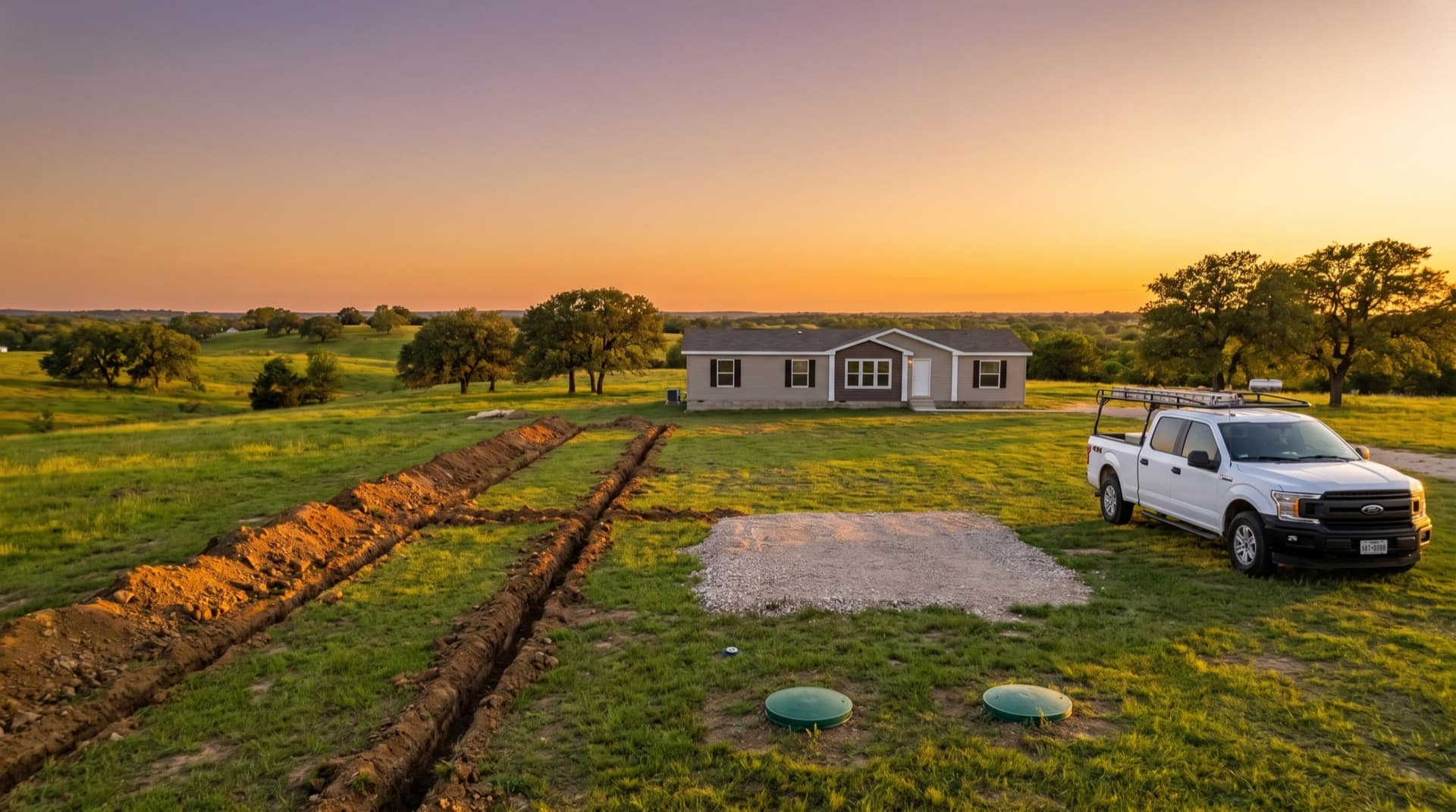
Septic System Installation in Waller, Texas
Licensed, bonded septic installers in Waller and across Waller County. We handle the soil test, the county permit, and the full install.
Licensed & Bonded
Texas OSF installer
Permitted & Inspected
County health-dept approved
New Installs Only
Built right the first time
Free Estimates
No-obligation, on-site
Instant Estimate
Your Waller septic estimate in 60 seconds
A few quick questions and you'll see your system size and a price range. No obligation, no contact info to start.
What are you installing a septic system for?
We specialize in new installs for homes on rural land.

Waller & Waller County
New construction, manufactured & mobile homes
Out around Waller, homes beyond the reach of city sewer run on their own septic system. We install new systems for new builds, manufactured homes, and mobile homes. We run the soil and perc testing, pull the Waller County permit, and build it to pass inspection the first time.
Get My Free EstimateWaller was platted in 1884 and named for Edwin Waller, and the city straddles the Waller–Harris county line on US 290. It has its own sewer; septic is for land beyond the reach of its lines.
Septic systems in Waller
K. H. Faulkner filed the plat establishing the town of Waller on January 11, 1884, naming it for Edwin Waller. Today the city runs its own sanitary sewer, and its code is direct: a building in the city with a city sewer main or lateral within 175 feet of the tract must connect, and on those lots a septic tank is unlawful (Secs. 82-44, 82-48). New subdivisions in the city and its extraterritorial jurisdiction must connect every lot to city sewer when it's available at the time the plat is recorded (Subdivision Ordinance §3.17), and septic drainfields must stay 150 feet from the city's public water wells (Sec. 82-253). Inside the city limits, building permits come from the City of Waller rather than Waller County Road & Bridge, and the city allows manufactured homes only in approved parks or subdivisions and bans mobile homes (Sec. 46-2). The county line runs through town, with close to half of the city in Harris County. On the Waller County side, Waller County Environmental's state-approved septic program covers the entire county ($310 for a single-family home). On the Harris County side, the county's program covers only unincorporated land ($223), so a Harris-side lot inside the city needs a check first.
Septic conditions around Waller
We ran 35 spots within 5 miles of downtown Waller through the same public data our free land check uses: the USDA soil survey, FEMA's flood maps and the National Wetlands Inventory. Here is what they show for a new septic system.
100%
35 of 35 spots
Soil the USDA rates "very limited" for a standard septic drainfield
100%
35 of 35 spots
Point to an aerobic system instead of a conventional drainfield
6%
2 of 35 spots
Inside a FEMA high-risk flood zone (the 100-year floodplain)
31%
11 of 35 spots
A mapped wetland within about 100 feet
Most of the ground around Waller won't take a standard gravity drainfield: water moves through the soil too slowly and groundwater sits close to the surface in wet months. Plan on an aerobic system with spray or drip dispersal, from $11,950 installed. The two soil borings on your own lot make the final call. Prices cover the system and installation; the site evaluation, design and county permit are quoted separately.
2 of the 35 spots are in a FEMA high-risk flood zone. A lot there adds floodplain rules to the septic design and usually a county floodplain permit, so check your lot's zone early.
Most common soils around Waller
| Soil | Spots | Drainfield rating | Main limitation |
|---|---|---|---|
| WockleyWockley-Urban land complex | 19 | Very limited | High water table, Slow drainage |
| HockleyHockley loamy fine sand, 1 to 3 percent slopes | 6 | Very limited | Slow drainage, High water table |
| TomballTomball loam, 0 to 1 percent slopes, frequently ponded | 5 | Very limited | Ponding, High water table |
| MockleyMockley fine sandy loam, 1 to 3 percent slopes | 3 | Very limited | Slow drainage |
| KatyKaty fine sandy loam, 1 to 3 percent slopes | 1 | Very limited | High water table, Slow drainage |
1 more spots on 1 other soil types.
A map sample isn't your lot. The USDA soil survey maps the landscape at 1:24,000, and Texas requires a licensed site evaluator or engineer to evaluate every tract before a permit (30 TAC §285.30). Run your own address through the free land check to see what the maps show for your lot.
Check my land freeSources: USDA NRCS Soil Survey (SSURGO), FEMA National Flood Hazard Layer, USFWS National Wetlands Inventory. 35 spots on a 1.6-mile grid, checked October 2, 2026.
What we install in Waller
Site Evaluation & Perc Testing
We evaluate your soil and run the percolation test that determines how well your ground absorbs water — the foundation of a system that works.
System Design & Sizing
We size the tank and drainfield to your home's bedroom count and your soil's absorption rate, then engineer a layout that fits your lot.
Permitting & County Approval
We prepare and submit your on-site sewage facility (OSF) permit application and coordinate approvals with your county health department.
Excavation & Site Prep
We prepare the site and excavate for the tank and drainfield with the right grade and setbacks — protecting your wells, structures, and property lines.
Tank Installation
We set the septic tank, connect the inlet and outlet plumbing at the correct grade, and install the effluent filter and risers for easy future access.
Drainfield Installation
We install the drainfield (leach field) that disperses treated effluent safely into the soil, sized to your percolation results and available area.


Built for Waller County soils
Advanced aerobic treatment systems
The USDA soil survey rates most of the ground around Waller "very limited" for a standard drainfield: it drains too slowly, holds a high water table part of the year, or both. On lots like that a standard gravity drainfield won't pass, so you'll need an aerobic system with drip or spray dispersal. We don't guess at it — the on-site soil test tells us exactly what your lot can take.
We handle Waller County permitting for Waller
Septic permits around Waller are issued locally, usually by Waller County. We put the application together, turn in the soil and design paperwork, and stay on it through approval and the final inspection — so you're not the one chasing the permit office.
New to septic? Our guides cover the basics: How Much Does It Cost to Install a Septic System in Texas? (2026) · What Size Septic Tank Do I Need? · What Is a Perc Test? How It's Done, Who Does It, and What It Costs
Local OSSF permitting authority: Waller County Environmental Division
Typical county permit fee: About $310 (county fees change — we confirm the current amount during permitting)
Permit steps, fees and FAQs for Waller CountyWhy Waller homeowners choose us
Licensed & Bonded
Move forward knowing your project is handled by a licensed, bonded installer.
New Construction & Mobile Home Specialists
We install new systems for new construction, manufactured, and mobile homes — so we're fast, precise, and up to date on the rules.
We Handle the Permits
Soil testing, design documentation, and county OSF approval — all managed for you.
Honest, Upfront Estimates
Clear, itemized quotes after we evaluate your site. No pressure, no surprises.
Local & Dependable
We know your county's requirements and show up when we say we will.
Built to Last
Properly sized, properly installed, and restored clean — a system you can forget about.
How your Waller install works
Instant estimate
Get a ballpark price for your Waller project online in about a minute.
Free on-site evaluation
We test your soil and confirm the right system for your lot.
Permit & design
We handle the Waller County OSSF permit end to end.
Install & inspection
Professional installation and final county sign-off.
What homeowners say
"Quick flow septic was a great experience!! Honest, good prices, and quick to respond to customer’s questions and concerns. Alex and his team will do everything to make it right. Would definitely recommend. 10/10"
"They handled our soil test, permit, and full septic install for our new build. The process was clear, the crew stayed on schedule, and the county inspection passed the first time."
The Ramirez Family
Montgomery County, TX
"We needed septic for our manufactured home and they took care of everything from design to approval. Clear pricing, good communication, and no surprises."
Carlos & Elena Martinez
Waller County, TX
"Our property was raw land and we did not know where to start. They sized the system, handled the county paperwork, and kept the project moving."
The Johnson Family
Liberty County, TX
"Responsive, professional, and familiar with the local requirements. They made the permit and installation process much easier than we expected."
Miguel Hernandez
Fort Bend County, TX
Waller septic questions
Do I have to connect to city sewer in Waller?
If a city sewer main or lateral runs within 175 feet of your tract, yes: the building must connect, and a septic tank on that lot is unlawful (Secs. 82-44, 82-48). The city doesn't publish a sewer map, so we ask City Hall where the lines run before we design. Sewer outside the city limits is billed at 1.5 times the inside rate.
Which county permits a septic system near Waller?
It depends on which side of the county line the lot is on. On the Waller County side, Waller County Environmental's program covers the entire county: $310 for a single-family home, and outside the city it issues the septic permit after the Road & Bridge development permit (inside the city, building permits come from the City of Waller). On the Harris County side, Harris County permits septic on unincorporated land ($223 plus an $18 affidavit fee), but not inside the city, so we check those lots first.
Can I put a manufactured home on a lot in Waller?
Inside the city limits, only in an approved manufactured home park or subdivision, and mobile homes aren't allowed at all (Sec. 46-2). Outside the city, a manufactured home on acreage needs its own septic system permitted by the county the land is in.
Will I need an aerobic septic system in Waller?
Probably. Of the 35 spots we checked within 5 miles of downtown Waller, 35 point to an aerobic system, mainly because water moves through the soil too slowly and groundwater sits close to the surface in wet months. Aerobic systems start at $11,950 installed (the site evaluation, design and permit are quoted separately). The two soil borings on your lot make the final call.
Is Waller in a flood zone?
Parts of the area are. 2 of the 35 spots we checked within 5 miles of downtown Waller are inside a FEMA Special Flood Hazard Area (the 100-year floodplain). Your own lot's zone is what counts, so run the address through our free land check before you buy or design.
Do you install septic systems in Waller?
Yes. We install new septic systems on land in and around Waller and across Waller County — for new construction, manufactured homes, and mobile homes. Inside city limits that have city sewer, you'll usually connect to the sewer instead.
How much does a septic system cost in Waller?
Most Waller installs run between $8,000 and $13,950 — $8,000 for a conventional system where the soil allows it, $11,950 for an aerobic spray system, and $13,950 for an aerobic system with drip dispersal. The soil evaluation (perc test), the engineered design, and the county permit are quoted separately. Run the instant estimate for a ballpark, and we'll confirm the exact number once we've seen the lot.
Do I need a permit for a septic system in Waller?
Yes. Every new septic system needs a permit and a soil evaluation before anyone digs. Around Waller the permit usually comes from Waller County, and we take care of all of it for you.
Check your Waller lot before you buy or build
Soil rating, flood zone, wetlands, and the likely septic system type for any Waller address — free, in seconds.

Get your free Waller septic estimate
Tell us a little about your Waller property and we'll size your system and set up a free visit. No pressure, no obligation.